Physicality I: Valuation and Abstraction
Recently I heard that the price of gold had "plummeted." This made me think: what does the price of a one-ounce gold coin represent here in the first world, versus what does it represent in the communities where it is mined? In New York, Shanghai, or London, an ounce of gold is worth around four thousand dollars; expensive to some, volatile to others, and constantly weighed against equities depending on whether inflation is in the news. With this four thousand dollars, you might be able to afford a month of rent in New York City, or perhaps a month of rent and a few meals. When we price this asset in the West, and by extension, price the value of a dollar, it becomes surprising to me that there is such a large disparity in the physical value of an ounce of gold. In a mining town in the interior of West Africa, an ounce of gold is worth far more physically. Depending on the country, an ounce of gold could purchase between 4 and 6 months of city-center rent, food, utilities, and entertainment. The metal itself has not changed in any way. What has changed is everything that surrounds it: the local wage, the cost of a day's living, the nation, and the distance to the mine it came from. The price is global, arrived at through worldwide supply and demand, yet the meaning of that price is entirely local. This divergence is a visible crack in a much larger structure. While global markets assign a uniform financial price to gold and other assets, this abstracted valuation masks profound differences in real-world physical utility and human value. This reveals how layers of financial and technological abstraction increasingly detach valuations from tangible reality, with AI exemplifying this shift.
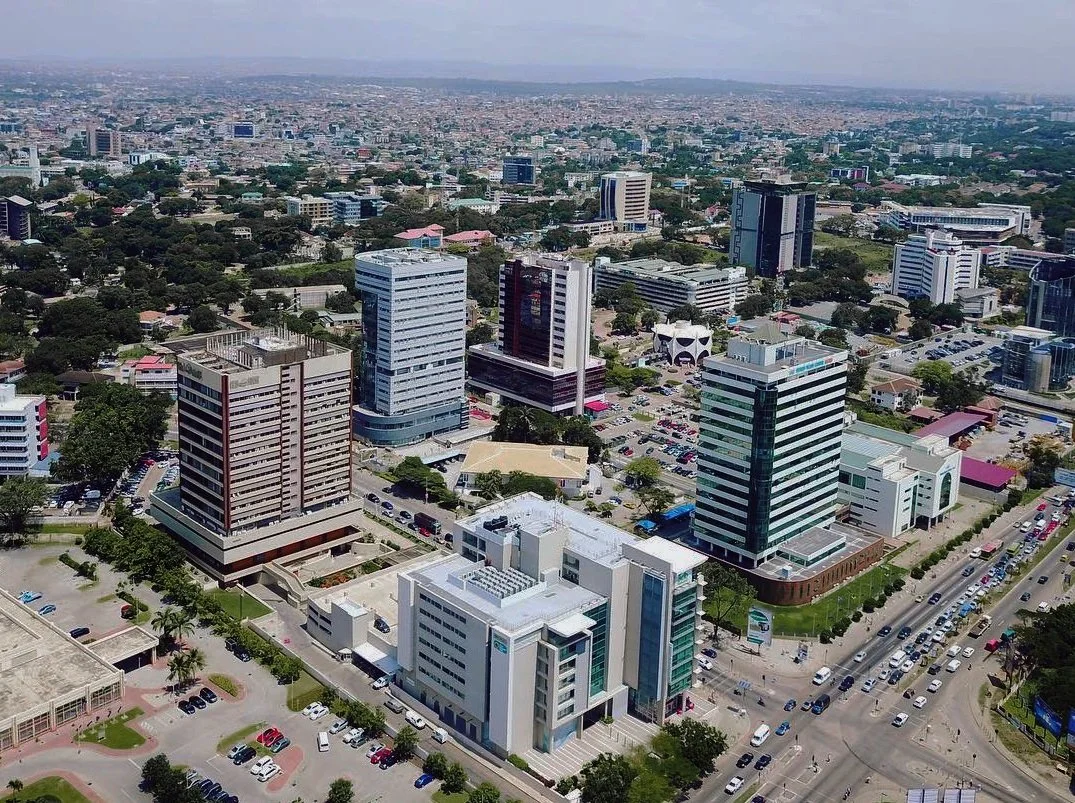
Accra, Ghana where a 1-bedroom apartment costs approximately $200/month.
Certain objects possess a value that exists prior to any market naming it, and gold is perhaps the most universally understood. Its worth is not argued so much as it is recognized. The metal is dense, so a considerable fortune can be carried in a closed hand; it does not corrode or decay, so it survives across generations; and it is scarce enough that no individual can simply manufacture more of it. Most importantly, it is understood by nearly all humans. A man who lacks all understanding of finance, or even literacy, still grasps the weight, the shine, and the way other men regard the metal in his hand, whether through observation, status, or human nature. This is precisely why gold has mattered most in the moments when everything else stopped mattering. In the collapse of Rome, in wars, and in every stretch of history when paper promises turned to nothing overnight, it was the physical possession of the metal, and not a certificate describing it, that carried a family through. The same principle extends to every object rooted in what I would call the real domain: land, resources, factories, and the mines themselves. Consider that the great fights over the physical control of a mine, for example, the nationalization disputes such as Oyu Tolgoi, are never fights over shares or term sheets. They are physical fights over the ground because every party involved understands that holding the earth beneath the metal is worth far more than any claim written about it.
Upon this physical foundation, modern finance constructs floor after floor, and each floor stands a little further removed from the ground. Futures, derivatives, exchange-traded funds, and paper claims of every description now sit between the buyer and the metal, the farm of grain, or the structure. The volume of gold traded on paper vastly exceeds the gold that is ever actually delivered; enormous quantities change hands as signals and positions while the physical metal sits still in a vault, wanted by almost none of those who trade it. In stable times this arrangement functions well enough, being highly liquid, but it conceals a fragility that reveals itself only under strain. When a sufficient number of holders demand the physical metal at once, the promises can outrun the bars, and the resulting squeeze, or outright failure to deliver, exposes the difference between owning gold and owning an abstracted claim on gold. Distant valuation methods reward liquidity and responsiveness to signals; they cannot reward control of the mine, and they cannot place a bar in your hand. Ergo, the entire structure holds only so long as no one insists upon the underlying. The moment physical control is asserted, through geopolitics, simple robbery, or state nationalization, paper derivatives instantaneously revalue to what is supported by the physical domain.
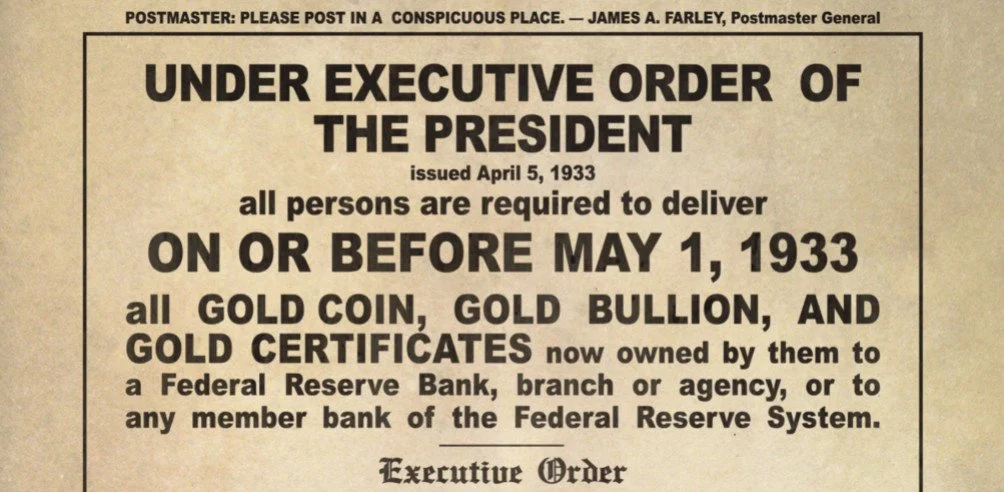
FDR's Executive Order 6102 - often talked about by “gold bugs” effectively outlawed the private ownership of gold coins, bullion, and certificates to combat the deflationary pressures of the Great Depression.
Artificial intelligence represents a purer form of this same abstraction, and it exposes the pattern more completely than any asset before it. Gold at least rests upon mining, upon labor, upon a metal one can close a hand around. AI rests upon nothing that can be held. Its value is generated entirely through code and digital output; it builds no bar, grows no crop, and raises no wall, and its improvements live wholly within the nonphysical world described above. Suppose it performs the work of five hundred thousand people sending emails. We must then ask the only question that ultimately matters, which is what has actually been made in the faster completion of busywork. The honest answer is nothing. No building stands that did not stand before, no field is harvested, and no ounce is drawn from the earth. Activity that was already abstract, "knowledge work," has merely been abstracted again. AI does not simply occupy the abstract realm; it deepens it, enabling ever more elaborate financial instruments, simulations, and paper fortunes that float free of mines, of labor, and of the innate properties of real things. It presents itself as value fully detached from matter, and measured by what it delivers to the physical world, it very nearly is. Similar to a mine or farm, plenty goes into producing the outputs of AI systems: power plants, data centers, and graphics cards. Nonetheless, AI sits at the far end of the line that begins with gold, providing abstract value with almost nothing remaining beneath it.
The ounce in the miner's hand and the claim on the Western exchange carry an identical price and share nothing else, and that single fact is the whole argument rendered in miniature. Climb from the metal to the futures contract to the purely digital, and at every step the distance widens between the abstracted price and the physical reality beneath it. This gap is visible in gold's split valuation across regions, and it asks something of what we consider "valuable." One can then possess a deliberate awareness of what still grounds us in the real domain: the mines, the innate worth of objects, and the physical control of both. Wealth and power have never resided in the description. More recently, power and utility have become detached from the market price. Power resides in the thing itself, and in a world that abstracts itself a little further each year, remembering that difference is not sentimentality but the beginning of understanding what is real.